There are trips you plan. And others that leave a mark before they’ve even begun.
On April 26th, 2026, it all starts in Rendeux. Bags are packed, bikes carefully boxed, and in our minds, we’re already heading to the other side of the world. Destination: Charles de Gaulle Airport, then a long-haul flight with Asiana Airlines to Incheon — South Korea’s ultra-modern gateway, set between the sea and the skyline just west of Seoul.
When we land, everything shifts. It’s bigger, faster, smoother. But this is only a transition. The real journey lies further east, deep in the mountains.
That first night in Incheon feels strange — a mix of fatigue, excitement, and reunions. Leo Lounela, Sivert Ekroll, Harry Doye, Noelle Buri, Sara Cortinovis… the full team is finally together. The tone is set: this won’t be just another trip.
Stepping into history – Pyeongchang
On April 28th, we leave the coast behind and head toward Pyeongchang, in the heart of Gangwon Province. The scenery gradually shifts — skyscrapers fade into mountains, highways into winding roads. We’re entering a different Korea.
And not just any place.
Pyeongchang still echoes through the world of sport. It hosted the 2018 Winter Olympic Games, where some of the most iconic performances took place. Very quickly, it becomes clear: we’re not riding in an ordinary place.
First training session — 37 km.
But no dirt yet, no race track. We head out on the road, discovering the surroundings at our own rhythm. And even there, the immersion is striking.
We pass beneath the Alpensia ski jump, where Kamil Stoch soared to Olympic gold. A bit further, the bobsleigh track — silent now, but once dominated by Francesco Friedrich. The legs are turning, but the eyes are working just as much.
We’re not sightseeing. We’re absorbing it.
Our base camp, Iwant Resort, sits directly across from the bobsleigh track, just 2 km from the race venue. The kind of place where you open the curtains in the morning to an Olympic view.
Getting lost to understand
The next day follows the same rhythm.
65 km. Still on the road.
The Korean mountains reveal themselves differently: long, steady climbs, fast descents, smooth asphalt. It’s fluid. Almost peaceful.
No technical challenges yet. Just volume. Flow. Letting the body reconnect after the long journey.
Tires humming on the tarmac. Breathing settling into rhythm.
These are the moments where a team truly comes together.
A different kind of course
Thursday — finally, we leave the road.
The course opens.
And everything changes.
From the first lap, the sensations are different. Back on dirt, feeling the grip, the effort, the constant need to push.
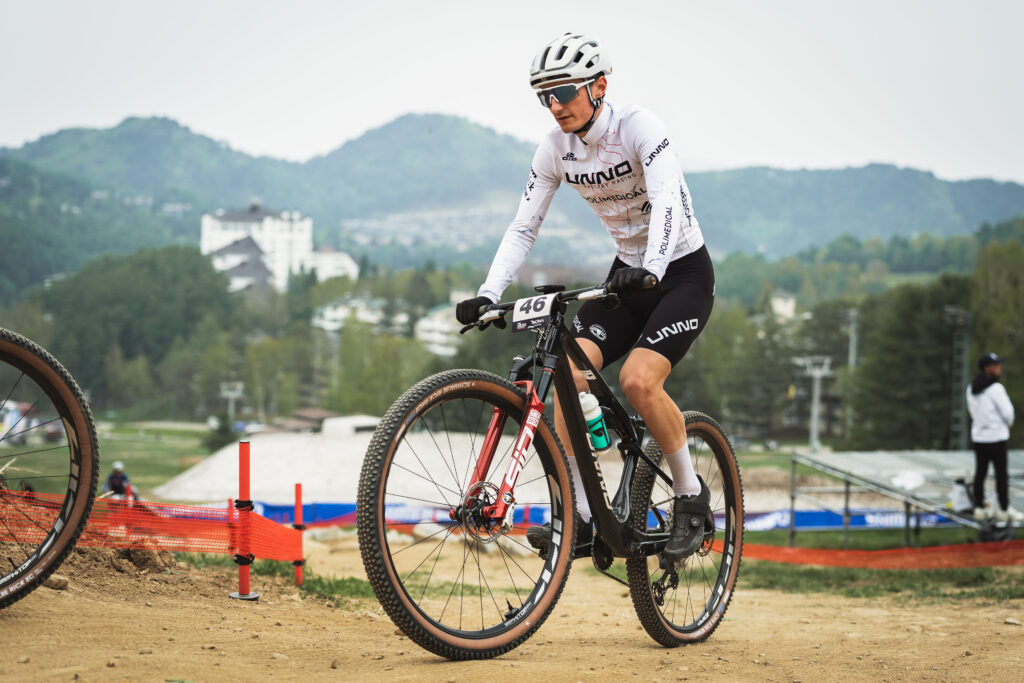
This isn’t the highly technical, tricky course you might expect from a World Cup. Instead, it’s physical. Relentless. There are few technical sections, but no real place to recover.
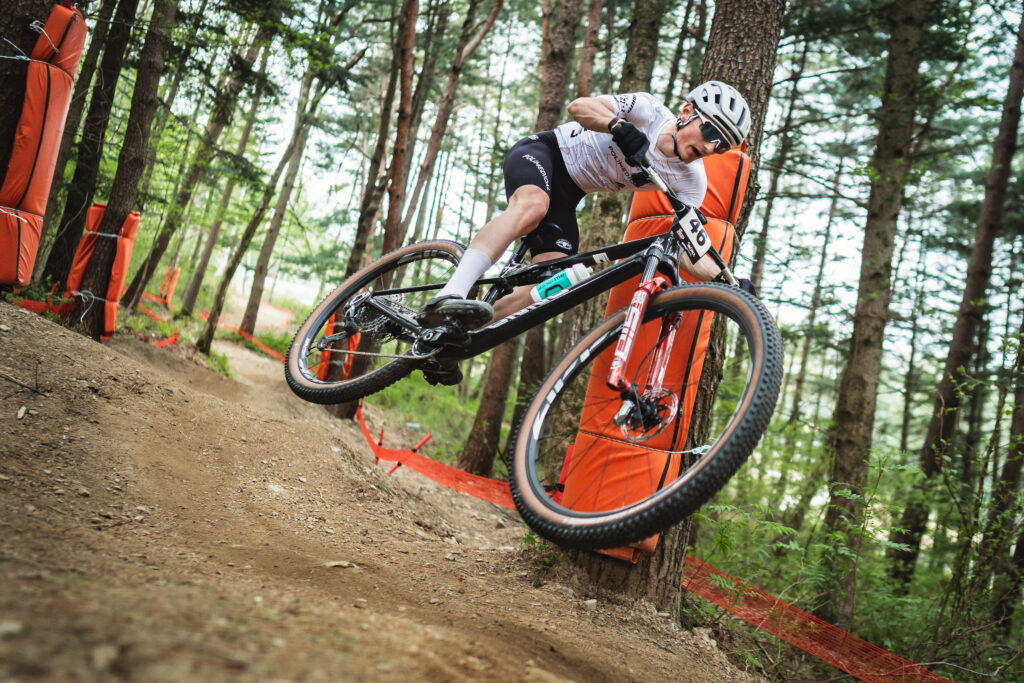
One feature stands out: a drop of around two meters. Not extreme, but enough to demand commitment, especially at race pace.
On the bike, the UNNO Horn feels perfectly suited — responsive, efficient, built for this kind of effort-driven course.
The RockShox Flight Attendant suspension proves invaluable. It constantly adapts — firm when pushing hard, instantly opening when the terrain demands it. On a course like this, that subtle efficiency becomes a real advantage.
For tires, the choice is clear: Schwalbe Rick. Fast, efficient, perfect for the dry and hard-packed conditions.
“Typical of Asian races,” my Japanese teammate tells me.
So this is it. A different racing philosophy. A different approach.
But already, something is shifting: the weather.
The calm before the storm
Friday — XCC day.
The pace is intense. Fast. Nervous.
Sivert delivers a strong 7th place. Sara fights for a solid 17th. Others push through crashes and setbacks. Leo goes down but gets back up. The team shows resilience.
As for me — 41st in the rankings. Just outside the cut. Frustrating, but clear.
So I adapt. I ride. I observe. I learn.
The course starts to feel familiar.
Or at least, that’s what we think.
When everything shifts
Saturday.
Final training. Final adjustments.
And then, the illusion breaks.
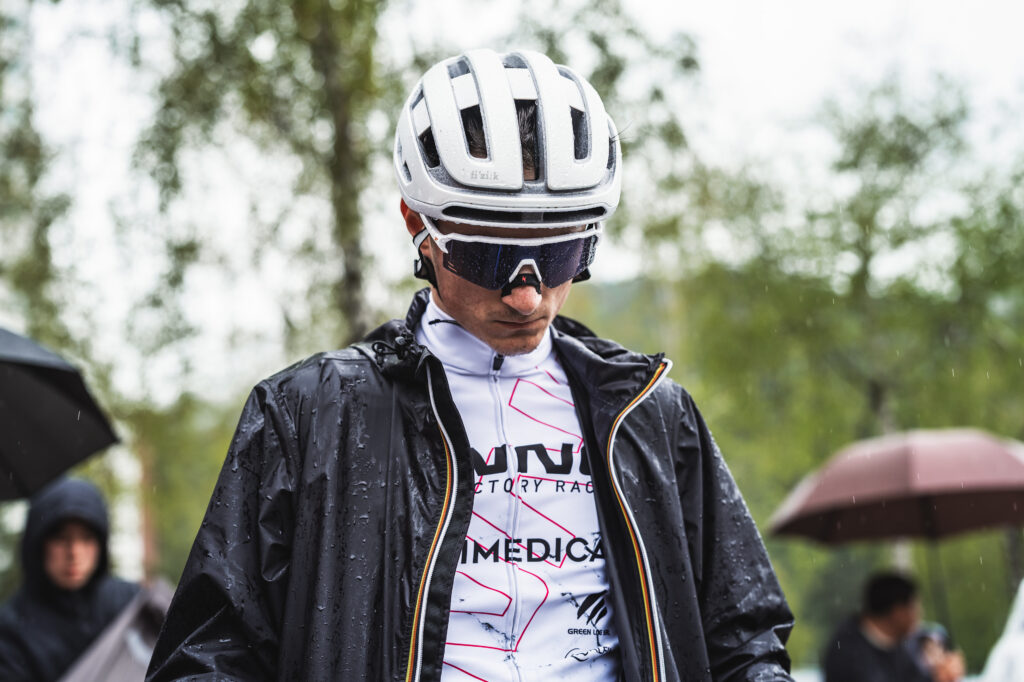
The rain arrives.
Not a passing shower — heavy, relentless rain. The kind that transforms everything.
The course changes completely. Grip disappears. Lines vanish.
The decision is immediate: we switch from Schwalbe Rick to Schwalbe Rocket Ron. More aggressive, better suited for the now muddy, unpredictable terrain.
What we had learned… no longer applies.
We hand over the bikes to the mechanics. Michael Vandermeulen, as precise and reliable as ever. Dom Geoghegan joins to support.
From here on, control fades.
The sound of rain
Sunday morning.
We wake up to it.
Rain. Constant. Deep. Unavoidable.
Dom heads out early to check the course. When he comes back, we don’t need many words.
“It’s a mess.”
And that’s exactly what it is.
The race becomes a battle of adaptation. Every corner is different. Every climb is a struggle. Every descent a risk.
The bike moves beneath you. Tires grip… then slip. Suspension works non-stop.
You’re no longer riding the course.
You’re surviving it.
Already leaving
And then, almost abruptly, it’s over.
No time to process. We pack up. Bikes, bags, everything.
Bus back to Incheon.
One last night.
Then a 14-hour flight back to Paris.
What remains
This wasn’t just a race.
It was a transition.
From road to dirt. From control to adaptation. From dry speed to unpredictable chaos.
Pyeongchang gave us all of that. And more.
Somewhere between smooth asphalt rides and a mud-soaked battlefield, one thing became clear:
you never really control everything.
You adapt.
And maybe that’s what travel — and racing — is really about.